
Powerful insights into how you can change habits
LEARNING NEW HABITS FOR BETTER HEALTH
OLD HABITS DIE HARD
There are many conflicting ideas about how long it takes to learn a new habit and I have looked
at research on the topic and found quite interesting facts about habit changing.
It is often believed, that it takes 21 days to change a habit. However, this belief is not based on
evidence, and in fact it stems from an investigation into how long it takes after a limb amputation
that the patient still feels the amputated limb. It was found that it takes on average 21 days for the
patient to not feel the amputated limb. I have to say though, I am not sure how reliable that
research was.
Research from University College London showed that the average time to learn a new habit is
about 66 days; however, individual times ranged from 18 to 254 days. As you can see, there’s no
typical time frame for breaking a habit, and a lot depends on your personality, your motivation,
the circumstances, and the habit you want to change. It has been demonstrated that learning new
habits that are aligned with your personal values will happen faster behaviour faster than if you
are changing habits for external reasons such as pressure from others.
What about breaking an unwanted habit?
Habit forming and habit breaking are quite closely linked. However, it has been demonstrated
that it is easier to start doing something new than to stop doing an unwanted habit.
In order to break a habit or learn new habits, you need to have very strong motivation, which will
keep you on track. If you have very strong reasons, they will keep you motivated during times
when you want to give up. It is very useful to use replacement habits or behaviours to change an
unwanted habit. For example, instead of drinking sugary drinks with your meals, you replace
them with sparkling water, or replacing a midmorning cupcake with a healthy snack made up of
fruit and nuts. Changing habits and learning new behaviours takes time - be patient - the longer
you’ve had a habit, the longer it will take to change or get rid of it.
Habits are literally entrenched at the neural level, that is neural pathways have been created in
your brain. For new habits, new neural pathways have to be created and that takes time. I encourage you to take small steps and learn one habit at a time. If you try and change too many habits simultaneously, you might find yourself overwhelmed and give up.
Often the "all or nothing" thinking occurs at the beginning of wanting to change your lifestyle.
This type of thinking is unhelpful and will lead to failure in the long run. Keep it simple and take one day at a time - that will ensure your success!
From research in psychology we know that changing habits and learning new ones is a process that consists of several stages.
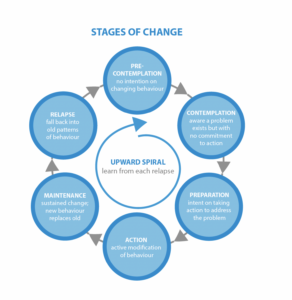
PRE-CONTEMPLATION
You have no intention to change
CONTEMPLATION
You are thinking about getting healthier, but you are not quite sure how to start.
You are not sure how to find the right food plan and exercise.
You feel you want to get healthier, but you are not ready to start.
PREPARATION
You are starting to make plans.
You go out and buy the runners and exercise clothes.
You start thinking about healthier food option and you go and stock up healthy food in the
kitchen.
ACTION
You have started exercising.
You have made healthy changes to your diet.
You have taken on new behaviours that lead to a healthy life style.
MAINTENANCE
You are now used to your new habits.
You are able to stick to your routine without thinking about it too much.
You had slip ups but you managed to learn from them
You are looking for creative ways to stick with your new routine.
RELAPSE
After making changes, some people will return to their previous problem behaviour. This can
happen at any time during the previous stages. Not everyone will experience relapse, but it is
always a risk. The key is to learn from a relapse and not beat yourself up over it.
It's important to understand the different stages of change. Knowing that there is a "relapse" stage helps to normalise that from time to time there will be a relapse. It will help you to stop beating yourself up, recognise it is only a stage, and continue with your goals.